VNA Forklift vs Reach Truck: Which Is Best for Your Warehouse?
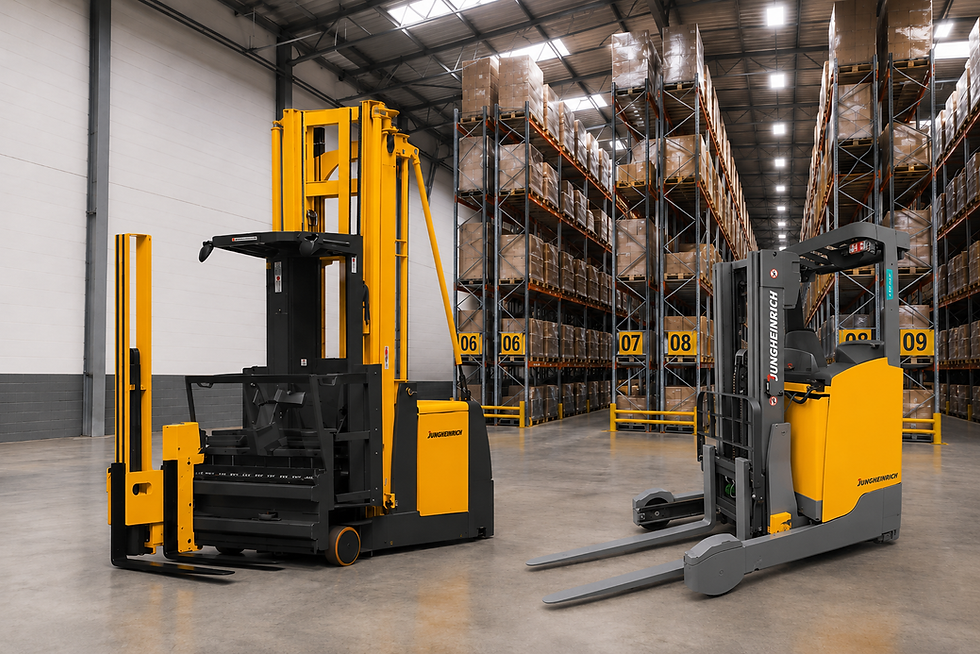
When planning a warehouse, choosing the right forklift can have a significant impact on storage capacity, productivity and long-term operating costs. It's also one of the most important decisions when planning Warehouse Optimisation. Two of the most common warehouse trucks are the VNA (Very Narrow Aisle) forklift and the reach truck.
Although they may appear similar at first glance, they are designed for very different warehouse environments.
In this guide, we'll compare VNA forklifts vs reach trucks, explaining the key differences, advantages and disadvantages, and helping you decide which solution is best for your operation.
What Is a VNA Forklift?
A VNA forklift (Very Narrow Aisle forklift) is designed to operate in extremely narrow warehouse aisles, allowing businesses to maximise storage density without expanding their building.
Unlike standard warehouse trucks, VNA forklifts are engineered to work at significant lift heights while maintaining excellent stability and precision.
Typical uses include:
High-bay warehouses
Distribution centres
Third-party logistics (3PL)
Manufacturing facilities
Cold storage warehouses
If you're considering introducing a VNA truck into your operation, explore our VNA Hire solutions.
What Is a Reach Truck?
A reach truck is designed for pallet handling in standard warehouse aisles.
Its extending mast allows operators to reach deep into pallet racking while maintaining good manoeuvrability.
Reach trucks are ideal where aisle widths are wider and maximum storage density is not the primary objective.
VNA Forklift vs Reach Truck
Feature | VNA Forklift | Reach Truck |
|---|---|---|
Aisle Width | Very Narrow | Standard |
Storage Capacity | Excellent | Good |
Lift Height | Very High | High |
Warehouse Density | Maximum | Moderate |
Best For | High-Density Storage | General Warehousing |
Guidance | Wire Guided or free ranging | Not required |
Productivity | Excellent in VNA Layouts | Excellent in wider aisles |
Aisle Width Comparison
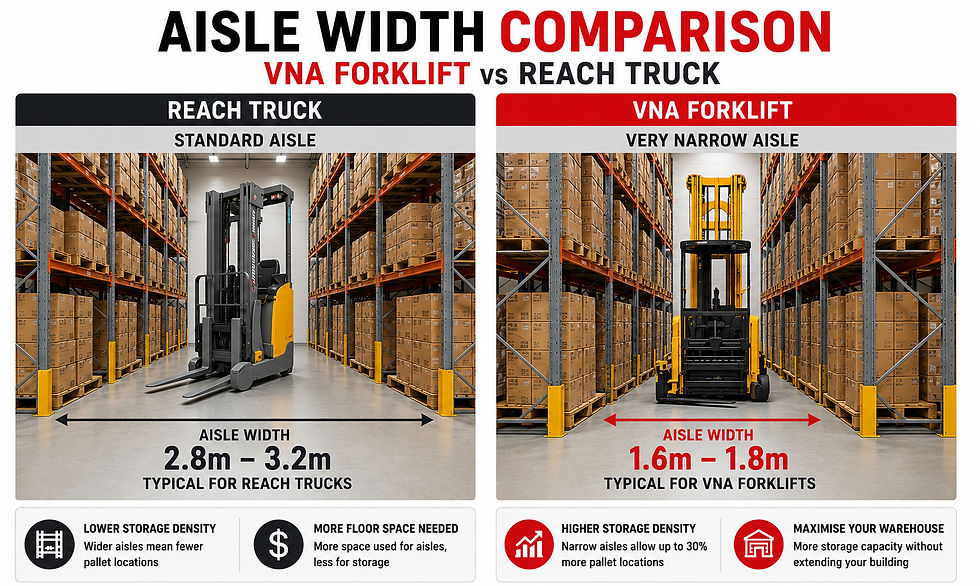
One of the biggest differences between the two machines is aisle width.
A VNA forklift can operate in considerably narrower aisles than a reach truck, allowing warehouses to fit additional racking within the same building.
For businesses looking to increase pallet positions without extending their premises, this can provide a significant increase in storage capacity.
Many VNA installations also incorporate Wire Guidance to maximise accuracy and operator confidence within very narrow aisles.
Lift Height
Both machines are capable of lifting to impressive heights, but VNA forklifts are specifically engineered for very high-level storage.
Combined with narrow aisle layouts, they allow warehouses to maximise both floor space and vertical
Storage Capacity
A VNA warehouse can often accommodate substantially more pallet locations than a warehouse using traditional reach truck aisles.
This is one of the main reasons why distribution centres and logistics companies invest in VNA systems.
Not sure whether your warehouse is suitable? Book a Warehouse Survey and we'll assess your current layout and recommend the most efficient solution.
Productivity
The right truck depends on your warehouse operation.
A reach truck offers excellent flexibility in standard warehouses.
A VNA forklift excels where high-density storage and repetitive narrow aisle operation are required.
Running Costs
Both truck types offer low operating costs when maintained correctly.
However, warehouse layout should always be considered rather than simply comparing the purchase price.
Choosing the correct truck for your application can reduce travel distances, improve picking efficiency and increase overall productivity.
Which Warehouse Should Choose a Reach Truck?
A reach truck is often the better option if:
Your aisles are already relatively wide.
You don't require maximum pallet density.
Lift heights are moderate.
Your warehouse layout is unlikely to change.
Which Warehouse Should Choose a VNA Forklift?
A VNA forklift is often the preferred solution if:
You need to maximise storage capacity.
Your warehouse uses high-level racking.
You operate dedicated narrow aisles.
You're planning a warehouse redesign.
You want to increase pallet locations without extending your building.
At Forklift Truck Depot Limited, we specialise in helping businesses maximise warehouse space through VNA solutions.
Can You Convert From Reach Trucks to VNA?
Yes.
Many businesses replace reach trucks with VNA forklifts as part of a warehouse optimisation project.
By redesigning aisle widths and installing the appropriate guidance system where required, businesses can significantly increase storage capacity while improving operational efficiency.
FAQs
Is a VNA forklift better than a reach truck?
Not necessarily. The right choice depends on your warehouse layout, storage requirements and operational needs. VNA forklifts excel in high-density storage environments, while reach trucks are ideal for standard warehouse aisles.
Do VNA forklifts need wire guidance?
Some do, but not all. Many VNA forklifts operate using wire guidance, while others are free-ranging and use alternative navigation systems.
Can a reach truck work in VNA aisles?
No. Reach trucks generally require wider aisles than VNA forklifts and are not designed for very narrow aisle applications.
Which forklift provides more pallet locations?
A VNA forklift can usually increase storage density because it operates in narrower aisles, allowing more racking to be installed within the same warehouse footprint.
Which forklift is cheaper to operate?
Operating costs depend on the warehouse layout, duty cycle, maintenance programme and utilisation. The most cost-effective solution is the truck that best matches your warehouse design.
Unsure Which Forklift Is Right for Your Warehouse?
Choosing between a VNA forklift and a reach truck isn't just about the truck itself—it's about creating the most efficient warehouse layout for your business.
At Forklift Truck Depot Limited, we specialise in VNA forklifts, warehouse optimisation and site surveys. Our experienced team can assess your operation and recommend the best solution to maximise storage capacity and productivity.

Related Guides

Comments